

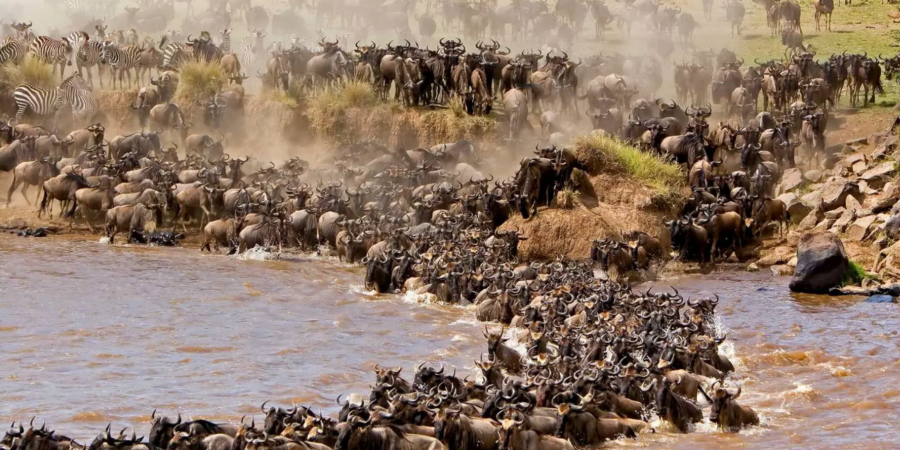
Ask most people what they know about the Great Migration, and they’ll describe dramatic river crossings — wildebeest launching themselves into crocodile-infested waters while tourists watch from the banks. It’s a spectacular image, and it’s completely real. But it’s also just one chapter in a year-long story that is far more complex, beautiful, and awe-inspiring than a single moment on a riverbank.
A great migration safari isn’t about catching one crossing. It’s about understanding one of the most extraordinary natural events on Earth and positioning yourself to witness whichever chapter moves you most. Here’s everything you need to know.
What Is the Great Migration?
The Great Migration is the largest overland animal movement on the planet. Approximately 1.5 to 2 million wildebeest, accompanied by hundreds of thousands of zebra and gazelle, make a continuous circular journey through the Serengeti ecosystem of Tanzania and Kenya’s Masai Mara, covering roughly 1,800 miles every year.
The word “migration” might imply a point A to point B journey, but this is a perpetual circle with no real beginning or end. The animals follow a primal instinct: always moving toward fresh grass and water, always following the rain. It’s been happening for hundreds of thousands of years, and it’s arguably the most important remaining mega-fauna migration on Earth.
The wildebeest are the headline act, but the drama they create touches the entire ecosystem. Lions, cheetahs, leopards, hyenas, and wild dogs time their movements and their hunting around the herds. Crocodiles grow fat during river crossing season. Vultures circle overhead. The Great Migration is an ecosystem event, not just a wildebeest parade.
The Great Migration Calendar: A Year in the Life
This is where most of the guides and pamphlets go wrong: presenting the Great Migration as a summer event. In reality, something remarkable is happening in the ecosystem every single month of the year. Here’s the full picture:
November – December: The Southern Journey Begins
As the short rains arrive in November, the wildebeest herds begin moving southeast from Kenya’s Masai Mara and Tanzania’s northern Serengeti into the short-grass plains of the southern Serengeti. The rain triggers new grass growth, and the herds follow instinctively.
This is a transitional, quieter periodm but beautiful in its own right. The landscape turns green almost overnight, the herds are on the move, and the tourist crowds have thinned considerably after peak season.
January – March: Calving Season in the Serengeti
This is one of the most overlooked and most spectacular periods of the entire great migration safari experience. Between January and March, the wildebeest gather on the short-grass plains of Tanzania’s southern Serengeti and Ngorongoro Conservation Area for calving season.
Approximately 500,000 wildebeest calves are born within a 3-4 week window — sometimes 8,000 in a single day! The plains become an incredible tableau of new life: wobbly-legged calves taking their first steps, mothers protecting their newborns, and predators (lions, cheetahs, leopards) feasting in what is arguably the greatest concentration of predator activity on Earth.
It is significantly less crowded than the famous river crossing season. For travelers willing to explore beyond the famous Mara crossing narrative, calving season delivers one of the most extraordinary wildlife experiences Africa offers.
Best for: Wildlife photographers, anyone interested in predator behavior, travelers avoiding peak-season crowds, couples seeking more intimate game viewing
Where: Southern Serengeti (Ndutu area), Ngorongoro Conservation Area, Tanzania
April – May: The Long Journey North
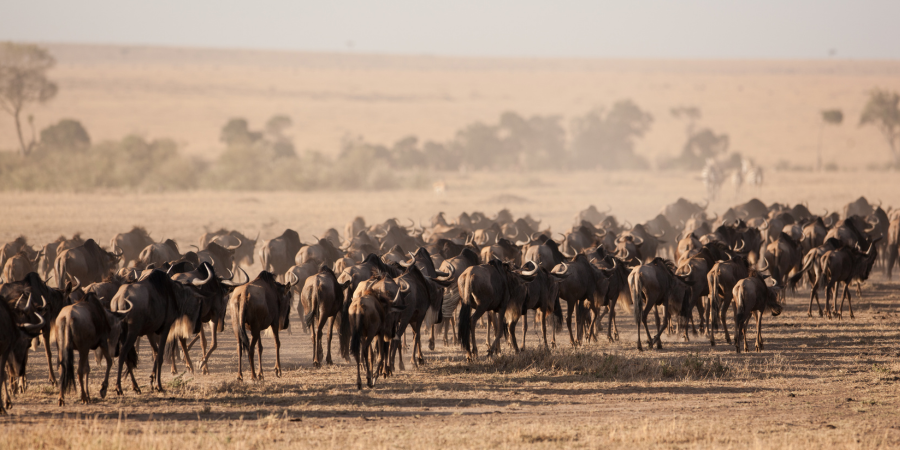
As the short rains end and the southern grass is exhausted, the herds begin their long march north through the western Serengeti. This is the quieter middle act, vast columns of wildebeest stretching to the horizon, covering ground steadily.
This is low season for tourism, which means dramatically lower rates and almost no other vehicles. The landscape is still lush and green from recent rains. For travelers who want to witness the sheer scale of the migration this period offers that experience in extraordinary solitude.
June – July: The Western Corridor and the First Crossings
By June, the herds reach the Grumeti River in the western Serengeti. This quieter river crossing often goes unnoticed by travelers focused on the Mara crossings further north, but Grumeti’s massive, ancient crocodiles are legendary. The water level is lower, the drama more contained, but genuinely spectacular.
July sees the advance groups reaching the northern Serengeti and beginning to approach the Kenyan border.
August – October: The Masai Mara and the Famous Crossings
This is the chapter that made the Great Migration famous. As the herds cross into Kenya’s Masai Mara, they must repeatedly cross the Mara River to access fresh grass on alternating banks. The crossings happen multiple times, driven by complex herd dynamics that no one (not even scientists!) can fully predict.
When a crossing happens, it’s overwhelming. Thousands of wildebeest launch themselves into the river simultaneously, fighting the current, navigating submerged rocks, avoiding crocodiles that have waited weeks for this moment. The noise is thunderous and their survival instinct is on full display.
But the crossings are unpredictable. The herds might approach the river, stare at it for hours, and then turn back. They might cross while you’re at breakfast and it’s over before you arrive. Or they might deliver multiple dramatic crossings in a single day.
This is also the most crowded and most expensive period for a great migration safari. Peak August sees significant vehicle density at popular crossing points, which can diminish the wilderness feeling.
Best for: First-time migration visitors, anyone who specifically wants to witness river crossings, travelers with flexible schedules who can wait for crossings
Where: Masai Mara National Reserve and surrounding private conservancies, Kenya
The Private Conservancy Advantage
The most important thing you can know about great migration safari planning: book in private conservancies surrounding the Masai Mara rather than (or in addition to) the national reserve itself, and book in advance! These private lands see a fraction of the vehicles, offer night drives (not permitted in the reserve), allow off-road driving, and often deliver equal or better wildlife viewing.
During peak migration season, witnessing a crossing from a private conservancy with one or two other vehicles is an entirely different experience from watching the same crossing with 50 vehicles.
What Drives the Great Migration?
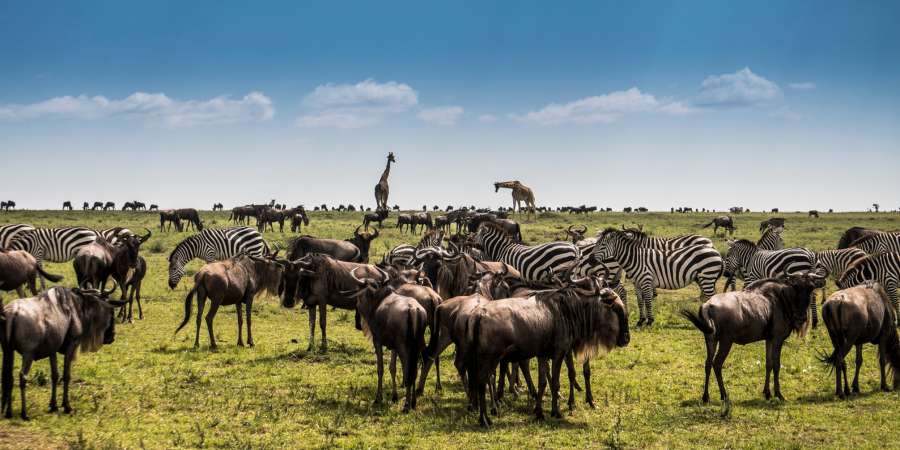
The wildebeest aren’t following a map or a schedule. They’re following rain, or specifically, the growth of new grass triggered by rainfall. Their movement is guided by a combination of instinct, smell, and an almost inexplicable collective intelligence.
They also follow a nutritional logic. The short-grass plains of the south are rich in phosphorus and calcium, which are essential for pregnant females. The long grasses of the north are higher in protein, essential for energy during the lean months. The circular route delivers different nutritional needs at different life stages throughout the year.
The zebra that accompany the wildebeest play an important ecological role too. Zebra eat the tall, tough tops of grass, exposing the shorter, more nutritious lower growth that wildebeest prefer. They’re not just traveling together by coincidence, they’re in a functional ecological partnership.
Tanzania vs. Kenya
A great migration safari can be witnessed in two countries, and the experience differs significantly:
Tanzania (Serengeti): Where the majority of the migration happens, for the majority of the year. Calving season, the long march, the Grumeti crossings, and the northern Serengeti in July-August are all Tanzania. The Serengeti is vast, you can have genuine wilderness experiences even during busy periods if you choose camps wisely.
Kenya (Masai Mara): Where the famous Mara River crossings happen between July and October. Smaller than the Serengeti but equally spectacular in terms of wildlife density during the migration months. Private conservancies surrounding the Mara offer some of the best migration safari experiences on the continent.
Can you do both? Yes, and for extended trips, we often recommend it.
Planning Your Great Migration Safari
The Great Migration operates on its own schedule, not yours. No operator can guarantee a river crossing, and anyone who promises specific sightings should be viewed with skepticism. At Hills of Africa, what we can do is position you in the right place at the right time, with excellent guides who read the landscape, and flexibility in your schedule to maximize your chances.
A few planning principles that make the difference:
Book private concession camps. During peak crossing season especially, private conservancies deliver a fundamentally different experience than the national reserve.
Allow at least 3-4 nights in migration areas. The herds move, the crossings are unpredictable, and longer stays dramatically increase your odds of witnessing the events you came for.
Consider calving season. January-February in the southern Serengeti is spectacular, less crowded, and often more affordable. For many experienced safari travelers, it’s actually the preferred season.
Combine with other destinations. A great migration safari pairs beautifully with Zanzibar or the Kenyan coast (beach extension), Ngorongoro Crater (incredible year-round), or Amboseli (elephant viewing with Kilimanjaro views).
Work with specialists. The logistics of positioning correctly for the migration [which camps, which conservancies, which timing] require genuine on-the-ground knowledge developed over many years.
After 25 years of planning great migration safaris, we still find this phenomenon one of the most incredible things Africa offers. There’s nothing manufactured about it: no schedule, no guarantee, no barriers between you and one of Earth’s primal forces. Just wildlife following instinct across a landscape they’ve traveled for millennia.
That’s worth planning for.
Interested in experiencing the Great Migration? Contact Hills of Africa to start planning your safari? Whether calving season, river crossing season, or the quieter, equally magical months in between, let us help you to plan the trip of a lifetime!